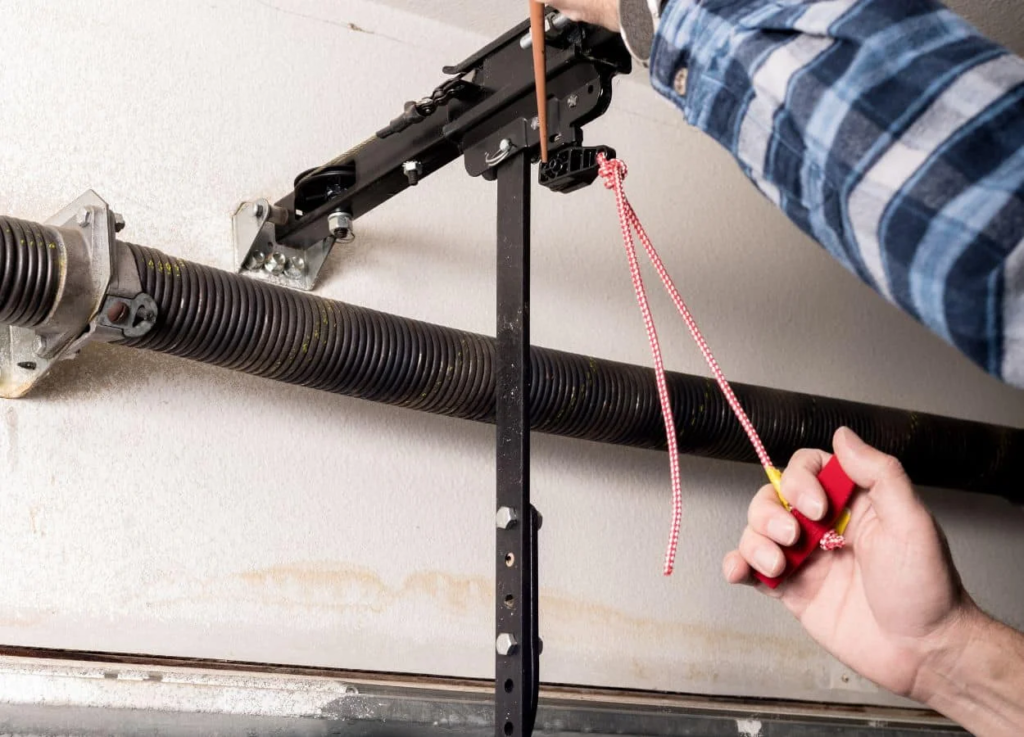
A garage door system is a mechanically balanced assembly consisting of torsion or extension spring systems, lift cables, roller assemblies, track channels, hinge hardware, and an electrically driven operator unit. Proper function depends on calibrated spring torque, structural alignment, and controlled frictional resistance across all load-bearing interfaces. Deviation in any subsystem produces measurable performance degradation and progressive mechanical failure. This document defines standardized field indicators used for diagnostic evaluation and early failure detection.
For professional service related to Garage Door Repair, evaluation should be performed within established mechanical tolerance and safety thresholds.
Acoustic Indicators of Mechanical Wear and Frictional Instability
Operational noise is a primary diagnostic variable in assessing system condition and component integrity.
Grinding noise indicates roller bearing wear or increased friction at the roller–track interface due to insufficient lubrication or contamination. Squeaking is typically associated with hinge pivot degradation or micro-movement in fasteners under cyclic loading. Rattling is consistent with fastener loosening due to vibration harmonics across repeated operational cycles. Impact or banging sounds may indicate torsion spring fatigue, sudden tension release, or panel misalignment under dynamic load conditions.
In a properly functioning system, acoustic output should remain limited to motor operation hum with no mechanical scraping or vibration noise. Any deviation from baseline acoustic performance indicates progressive wear.
Lithium-based grease is the industry-standard lubricant for high-load mechanical interfaces due to its shear stability and resistance to particulate accumulation.
Kinematic Performance Deviation: Slow or Non-Uniform Door Movement
Reduced cycle speed or inconsistent motion profiles indicate increased system resistance or counterbalance imbalance.
Primary causation includes torsion spring fatigue, extension spring elongation, roller friction increase, or physical obstruction within the track channel. The spring system is responsible for neutralizing gravitational load; degradation results in increased motor torque demand and reduced operational efficiency.
Uneven travel between left and right door sections indicates lateral load imbalance, typically caused by track misalignment or differential roller wear.
A manual balance test performed with the operator disengaged should result in static equilibrium at mid-travel. Any gravitational drift indicates spring calibration outside acceptable operational tolerance.
Failure to correct imbalance conditions results in accelerated operator motor degradation and gearbox wear.
System Non-Responsiveness and Operational Failure Modes
Complete or partial actuation failure typically results from electrical discontinuity or mechanical lockout conditions.
Common failure points include photoelectric safety sensor interruption, control board failure, circuit disruption, or mechanical breakage such as cable failure or torsion spring fracture.
Safety sensors operate via infrared beam transmission; interruption due to contamination, misalignment, or obstruction triggers fail-safe reversal logic. Electrical failure requires verification of power supply integrity, relay function, and control board output.
Mechanical failures such as broken springs or frayed cables prevent motion due to exceeded load capacity thresholds.
Under no conditions should force be applied to a non-responsive system due to risk of secondary structural failure.
For professional diagnosis and corrective repair, schedule evaluation through Ben Garage Doors LLC consultation services.
Structural Integrity Defects and Visible Mechanical Degradation
Visible deterioration is a high-confidence indicator of progressive system failure.
Observed conditions include cable fraying, torsion spring corrosion, track deformation, hinge fatigue, and panel deflection under static load.
Cable fraying represents a critical failure state due to reduced tensile load capacity and increased risk of sudden rupture. Track deformation results in roller binding and increased frictional resistance, producing secondary stress across the drive system.
Corrosion on torsion springs reduces fatigue life and increases fracture probability under cyclic loading. Panel sagging indicates compromised structural rigidity or uneven load distribution across support hardware.
Routine inspection of all mechanical interfaces is required to maintain operational safety compliance.
Safety Reversal Events and Load Imbalance Conditions
Uncommanded reversal during closure cycles is a protective response triggered by obstruction detection or system imbalance
Photoelectric sensors function as primary safety interlocks. Signal disruption due to misalignment or contamination results in false obstruction detection. Alternatively, excessive mechanical resistance caused by spring fatigue or track binding can trigger reversal under motor strain thresholds.
Persistent reversal behavior indicates unresolved mechanical imbalance or sensor calibration failure. Continued operation under these conditions increases system-wide mechanical stress.
Environmental Sealing Failure and Thermal Efficiency Loss
Perimeter sealing systems maintain thermal isolation and prevent particulate ingress. Seal degradation occurs due to material fatigue, UV exposure, and compression cycling.
Failure of bottom seals or side weather stripping results in measurable thermal inefficiency and uncontrolled environmental exchange. Secondary effects include moisture ingress and accelerated corrosion of internal components.
Seal integrity must be maintained within defined compression and elasticity tolerances to ensure system efficiency.
Operator Overload and Electrical Stress Conditions
Garage door operators are engineered for specific torque and load thresholds. When mechanical resistance exceeds design parameters, motor strain increases proportionally.
Symptoms include delayed actuation, thermal odor emission, intermittent response, and circuit protection activation.
Primary causation is typically upstream mechanical resistance, most commonly spring imbalance or roller friction increase.
Sustained operation under overload conditions results in premature motor winding degradation and gearbox wear.
Sensor Misalignment and False Activation Events
Photoelectric safety systems require precise optical alignment. Misalignment introduces signal instability and false reversal triggers.
Contamination, vibration, or structural shift can alter beam alignment geometry. Environmental interference such as direct sunlight may introduce signal noise in low-tolerance systems.
Corrective action requires optical recalibration and secure mounting verification.
Energy Efficiency Degradation Due to Structural Gaps
Loss of enclosure integrity results in increased thermal exchange rates and reduced energy efficiency.
Gaps caused by panel misalignment, seal degradation, or structural warping allow uncontrolled airflow and environmental infiltration. This increases HVAC load in connected structures and accelerates internal component wear due to moisture exposure.
Fastener Loosening and Progressive Structural Instability
Continuous vibration cycles induce micro-movement in mechanical fasteners, resulting in reduced preload over time.
This leads to increased structural deflection, noise generation, and secondary misalignment across connected components.
Routine torque verification and fastener re-tensioning are required to maintain structural integrity.
Preventive Maintenance and System Lifecycle Management
Preventive maintenance significantly reduces failure probability and extends operational lifespan. Standard procedures include lubrication of friction interfaces, spring balance testing, sensor calibration, track alignment verification, and hardware torque inspection.
Service intervals should be determined based on cycle frequency, environmental exposure, and system age.
For professional inspection and corrective maintenance, schedule service through Ben Garage Doors LLC.
External Technical Reference
For a detailed technical overview of garage door systems, including structural components and operational mechanics, refer to garage door systems
Conclusion
Garage door system degradation follows predictable mechanical failure pathways governed by cyclic fatigue, load imbalance, and frictional wear accumulation. Early detection of acoustic, kinetic, structural, and electrical anomalies is essential to prevent systemic failure.
Corrective intervention must be executed within defined mechanical safety parameters, particularly for high-tension components such as torsion springs and lift cables.